SiSiB PC2000: Bis(3-triethoxysilylpropyl)tetrasulfide
Synonym: Bis(3-triethoxysilylpropyl)tetrasulfane
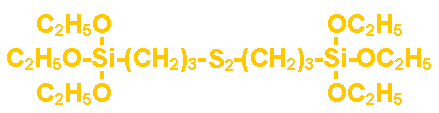
SiSiB PC2200: Bis(3-triethoxysilylpropyl)disulfide
Synonym: Bis(3-triethoxysilylpropyl)disulfane
Introduction
Heretofore, carbon black has been used as a reinforcing filler for rubber because carbon black provides higher reinforcement and more excellent abrasion resistance than other fillers. Recently, because of social requirements to save energy and to save resources, particularly to cut down fuel consumption of automobiles, a decrease in the heat buildup of rubber compositions is also required.
For decreasing the heat buildup of rubber compositions by using carbon black, use of a small amount of carbon black or carbon black having a large particle size is considered. It is, however, well known that, in both methods, decreasing heat buildup is in a contradictory relation with improving reinforcement and abrasion resistance of a rubber composition.
On the other hand, silica is known as a filler which provides decreased heat buildup of a rubber composition. However, silica particles tend to cohere together due to hydrogen bonding of silanol groups which are functional groups on the surfaces of the silica particles. For improving the dispersion of silica particles into rubber, the mixing time must be increased. When dispersion of silica particles into rubber is insufficient, a problem arises in that processability in processes such as extrusion and the like deteriorates due to the increase in the Mooney viscosity.
Moreover, the surfaces of the silica particles are acidic. Therefore, there are problems in that basic substances used as vulcanization accelerators are absorbed such that vulcanization is not carried out sufficiently, and a sufficient modulus of elasticity is not obtained.
In order to solve these problems, we developed various types of silane coupling agents. For example, PC2000 and PC2200. In the following article we would like to inform you about the silane coupling agent SiSiB PC2000, PC2200 and its other commercial forms PC2000B and PC2000S.
Silane coupling agent SiSiB PC2000
REINFORCING AGENT
Chemical Structure

Typical Properties
| Chemical Name |
Bis(3-triethoxysilylpropyl)tetrasulfide |
| CAS No. |
40372-72-3 |
| EINECS No. |
254-896-5 |
| Chemical Structure |
(CH3CH2O)3-Si-C3H6-S4-C3H6-Si-(CH3CH2O)3 |
| Color and Appearance |
Yellowish clear liquid |
| Density(16/24°C)( g/cm3) |
1.1 +/- 0.02 |
| Empirical Formula |
C18H42O6S4Si2 |
| Molecular Weight |
539 |
| Secondary Components: |
Propyltriethoxysilane, Chloropropyltriethoxylsilane, Ethanol |
Boiling Point at
1013 mbar |
Decomposition above 250°C |
| Pour Point |
App. -80°C |
| Flash Point |
Min. 100°C |
| Volatiles components(%) |
<= 4.0 |
| Average chain length(%) |
3.75 +/- 0.15 |
Total Sulfur
(standard value)(%) |
22.7 +/- 0.8 |
| Soluble in |
Primary alcohols, ketones, benzene, toluene, chlorinated hydtocarbons, acetonitrile, dimethylformaminde, dimethysulfoxide |
| Insoluble in |
Water |
| Storage Stability |
Five years at room temperature in original sealed container |
| Packing |
200kg drum, 1000kg Container |
PC2000 is a bifunctional polysulfidic organosilane for the rubber industry defined chemically as Bis(3-triethoxysilylpropyl)tetrasulfide. It is used to improve the reinforcing capability of fillers with silanol group on their surface (e.g., silicas, silicates, clay, etc.), and also as an integral part of curing systems to improve crosslinking network properties.
DOSAGE
Suggested dosage per 100 parts of filler:
For silica-------------------3~13 parts
For clay and talc----------0.5~1.0 parts
When used in rubber compounds, it produces these effects:
Coupling agent for non-black pigments.
Cure equilibrium for reversion resistance.
Curing agent for good heat aging.
Coupling Agent - With as little as 0.5 to 1.0 phr with clay fillers and 1.0 to 4.0 phr for silica pigments, PC2000 couples the non-black pigment and elastomers resulting in increases in modulus and increase in abrasion resistance.
Cure Equilibrium - PC2000 has four sulfur atoms positioned in the center.
At cure temperatures, these participate with sulfur in producing polysulfidic crosslinks. The PC2000 replaces crosslinks broken during cure, resulting in reversion resistant, and with proper compounding, reversion free compounds. This is known as equilibrium cure. The dynamic flex characteristics, E.G., heat generation and crack growth, are dramatically improved.
Curing Agent - Removing all sulfur from the compound for NR, SBR, NBR and replacing it with PC2000 and certain thiuram accelerators, produces compounds with excellent heat aging characteristics in addition to the coupling effects.
PC2000 is a silane coupling agent that has crosslinking and accelerator activity in rubber compounds.
Silane coupling agent SiSiB PC2000B
REINFORCING AGENT
COMPOSITION:
A 1:1 blend of N 330 carbon black and PC2000.
Typical Properties
| Appearance |
black powder |
| Ash%, 2g, 4H@ 1000 +/- 25°C |
12.0 +/- 1.0 |
| Sulfur Content, % |
12.0 +/- 1.0 |
| Heating loss, % |
<= 2.0 |
| Volatiles, 2h, 105°C,% Vacuum Distillation |
4.0 Max |
| Chloride Content, % |
0.35 max |
| Insoluble substance of butanone,% |
49.0-55.0 |
| Acetone Extract, % |
46.5-48.5 |
| Storage Stability |
one year under normal storage conditions |
| Packaging |
25 kg, 40kg PE drum |
Silane coupling agent SiSiB PC2000S
REINFORCING AGENT
COMPOSITION:
Mixture of PC2000 and dispersed precipitated silica in a relation of 1:1 by weight.
Typical Properties
| Appearance |
White to light yellow powder |
| Ash%, 2g, 4H@ 1000 +/- 25°C |
12.0 +/- 1.0 |
| Sulfur Content, % |
12.0 +/- 1.0 |
| Heating loss, % |
<= 2.0 |
| Chloride Content, % |
0.35 max |
| Insoluble substance of butanone,% |
50.0-55.0 |
| Acetone Extract, % |
46.5-48.5 |
| Storage Stability |
3 months under normal storage conditions |
| Packaging |
25 kg, 40kg PE dru |
However, when the mixing temperature of rubber is low, the sufficient reinforcing effect is not obtained by this type of silane coupling agent. Dispersion of the silica into the rubber is also inferior, and this causes deterioration of the low heat buildup property that is the strong point of a rubber composition containing silica. Moreover, the silane coupling agent is hydrolyzed, and the generated ethanol does not vaporize sufficiently and vaporizes during extrusion. Thus, there is a drawback in that blisters are formed.
On the other hand, when mixing is conducted at high temperatures of 150.degree. C. or more, the reinforcing property is improved. However, as a drawback, the polysulfide is to decarbolize to form free sulfur during mixing at high temperatures of 150°C or higher. The free sulfur will result in the vulcanization of rubber at the temperatures. So that, in this temperature range, gelation of the polymer reduces the rheological property of system. Thus, processing in later stages becomes impossible in actuality.
To prevent gelation of the polymer, it is necessary to reduce the content of high polysulfide silane such as pentasulfide silane, heptasulfide silane, hexasulfide silane, and the like, in the polysulfide Silane. Therefore, as a result we developed a novel silane coupling agent SiSiB PC2200 which is suitable for mixing at a high temperature.
The novel silane coupling agent SiSiB PC2200 solves the above problems of the conventional art. The polysulfide structure in which the distribution of sulfur is specified can ensure its stability at high temperature. Thus, it can be avoided to decarbolize to form free sulfur. The silanol group on the surface of silica can react sufficiently with the silane coupling agent. And at the same time, the dispersion of the silica into a rubber is remarkably improved, furthermore there are no effect on the property processing. Thus it can improve the productivity of rubber processing and the low heat buildup property and abrasion resistance is improved.
Silane coupling agent SiSiB PC2200
REINFORCING AGENT
Chemical Structure

Typical Properties
| Chemical Name |
Bis(3-triethoxysilylpropyl)disulfide |
| CAS No. |
56706-10-6 |
| Chemical Structure |
(CH3CH2O)3-Si-C3H6-S2-C3H6-Si-(CH3CH2O)3 |
| Color and Appearance |
Light Yellowish liquid |
| Density(16/24°C)( g/cm3) |
1.03 +/- 0.02 |
| Empirical Formula |
C18H42O6S2Si2 |
| Molecular Weight |
486 |
| Secondary Components |
Propyltriethoxysilane, Chloropropyltriethoxylsilane, Ethanol |
| Flash Point |
>120°C |
| Volatiles components(%) |
<= 4.0 |
| Average chain length(%) |
2.35 +/- 0.15 |
| Total Sulfur(standard value)(%) |
15.2 +/- 0.5 |
| Soluble in |
Primary alcohols, ketones, benzene, toluene, chlorinated hydtocarbons, acetonitrile, dimethylformaminde, dimethysulfoxide |
| Insoluble in |
Water |
| Storage Stability |
Five years at room temperature in original sealed container |
| Packing |
200kg drum, 1000kg Container |
Area of rubber industry where them would be beneficial
Footwear
- Abrasion resistance
- Cutting and chunking resistance
- Flex life improvement
Rolls
- Abrasion resistance
- Aging resistance
- Processing
- Set reduction (better load bearing)
- Reduced water swell
- Lower hysteresis
Mechanical Molded Goods
- Increased modulus
- Better heat aging
- Compression set reduction
- Dynamic property improvement
- Reduced swell to polar liquids
- Filler substitution (non-black for black)
Hose
- Improved abrasion on cover
- Better heat aging
- Increased modulus
- Lower compression set
- Improved adhesion to reinforcing elements
Solid Tires
- Improved abrasion
- Lower hysteresis
- Higher modulus
- Improved processing
- Possibly better adhesion
Tires
- Treads for abrasion, hot tear
- Carcass for adhesion and/or filler substitution
- Breaker (belt) stocks for adhesion
Belts
Flat Belts
- Increased abrasion
- Improved reversion resistance
- Reduced cost with clay substitution for black
- Improved cord adhesion
- Increased flex life and modulus
V Belts
- Increased modulus
- Improved abrasion
- Longer flex life
- Improved adhesion to reinforcing elements
|